

Electric Water Heater
To compare water heater manufacturers, check three things: the heater types they build, whether they can configure each model for your market’s voltage, plugs and certifications, and whether their factory can prove consistent quality. In this article, SONHA Water Heater covers instant, storage and heat pump water heaters, a pros-and-cons comparison, eight buying criteria, and safe use and maintenance, plus how we at SONHA Water Heater supply importers and distributors.
| At a glance: A water heater is an appliance that heats mains water for showers, basins and kitchens. Electric water heaters come in three main types: instant (about 3,500–4,500 W), storage (usually 15–100 L) and heat pump (usually 150 L and above). For importers, the right choice depends on household demand, the target market’s voltage and plug type, and the certifications that market requires. |
1. What Is a Water Heater?
A water heater is an appliance that heats cold mains water for showers, basins and kitchens at a controlled temperature. It can run on electricity, gas, solar energy or a heat pump. Electric models are widely used in homes because they need no gas line or flue.
An electric storage water heater has five core parts:
- Inner tank: holds the water, usually enamel-coated steel.
- Heating element: heats the water inside the tank.
- Thermostat: switches the element on and off to hold the set temperature.
- Anode rod: a magnesium or aluminium rod that corrodes instead of the tank.
- PU foam insulation: keeps the water hot between uses.
A pressure relief valve and an ELCB (earth-leakage circuit breaker) protect the user and the appliance.
2. What Are the Common Types of Electric Water Heaters?
Electric water heaters come in three main types: instant (tankless), storage (tank) and heat pump. Most water heater manufacturers build all three, each suited to a different kind of home.
2.1. Instant (Tankless) Electric Water Heaters
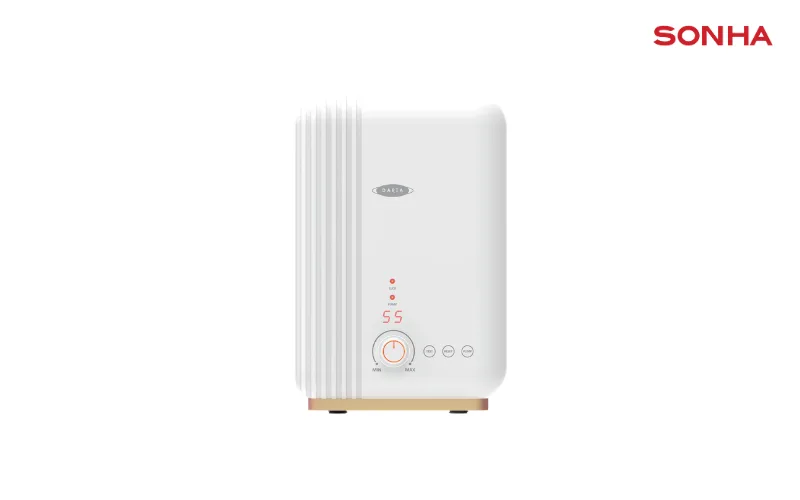
Here are the key operational characteristics of instant electric water heaters:
- How it works: heats water only while it flows, with no tank.
- Power: typically 3,500–4,500 W; some models add a booster pump.
- Suited to: one bathroom, small apartments and warm climates.
- Limit: output drops when several taps run at once.
2.2. Storage (Tank) Electric Water Heaters
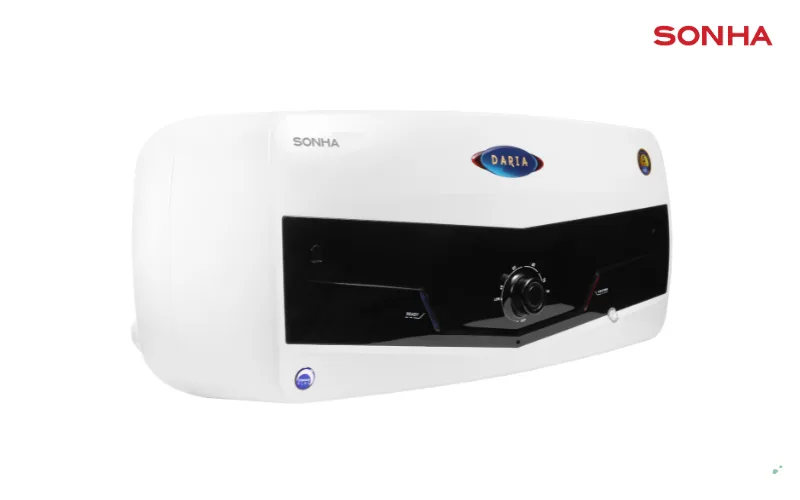
The specifications and main features of storage water heaters include:
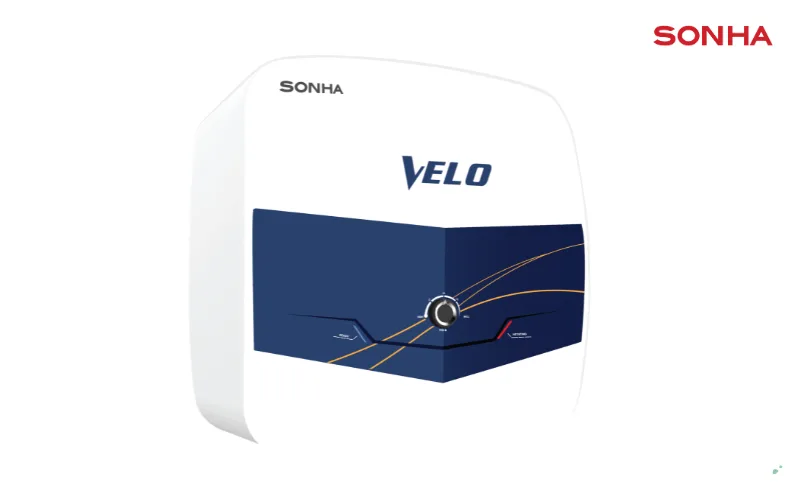
- How it works: heats a fixed volume of water and keeps it hot in an insulated tank.
- Capacity: 15–100 L, in slim, square or cylindrical shapes, mounted horizontally or vertically.
- Power: usually 1,500–2,500 W, a lighter load on household wiring.
- Suited to: families and homes with several outlets in use at once.
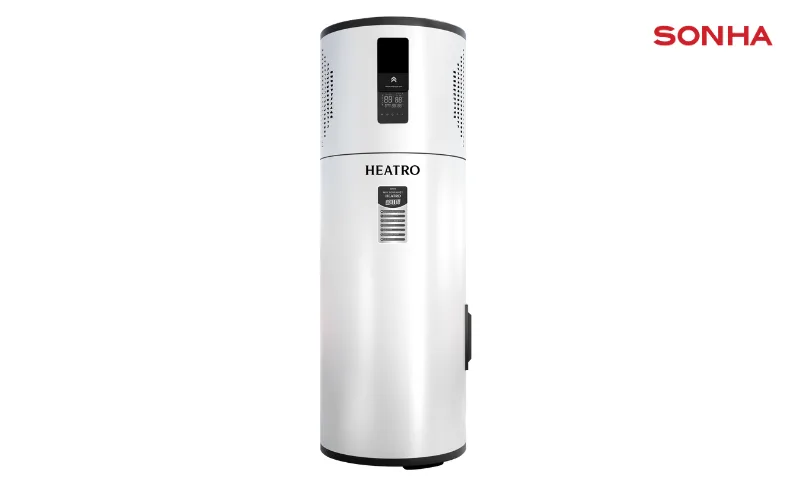
2.3. Heat Pump Water Heaters
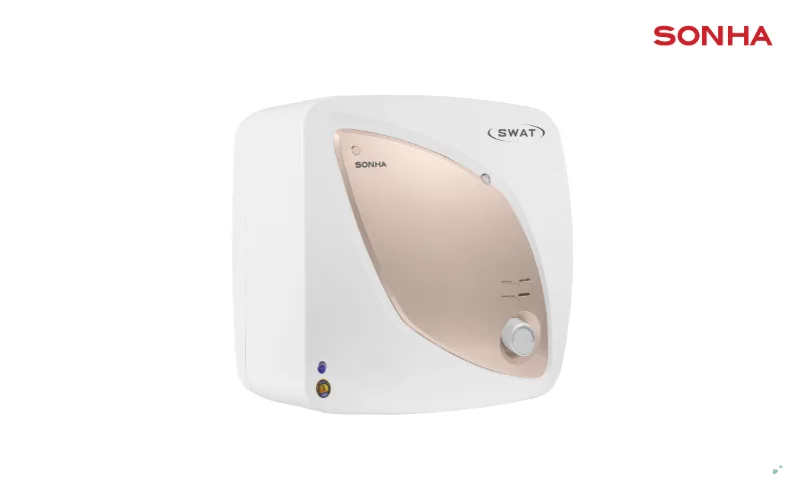
Here is an overview of the design and operation of heat pump water heaters:
- How it works: moves heat from the surrounding air into the water, like an air conditioner in reverse.
- Backup: most models carry an electric element, so they are also called hybrid water heaters.
- Capacity: usually 150 L or more.
- Suited to: high hot water demand and low running costs, in a space that stays between 4.4°C and 32.2°C (40–90°F) year-round.
3. Instant vs Storage vs Heat Pump Water Heaters: Pros and Cons Compared
No single type of water heater suits every home: the right choice depends on the number of outlets, the electrical supply, the climate and the budget. The table below sets the three side by side.
| Criteria | Instant (tankless) | Storage (tank) | Heat pump |
|---|---|---|---|
| How it heats | Heats water as it flows | Heats and stores water in a tank | Moves heat from the air into a tank |
| Typical power | About 3,500–4,500 W | About 1,500–2,500 W | Low compressor input, backup element |
| Capacity or output | Limited by flow rate | 15–100 L | Usually 150 L and above |
| Outlets served at once | One, sometimes two | Several | Several |
| Energy efficiency | No standby heat loss | Some standby heat loss | 2–3× resistance models |
| Upfront cost | Low to medium | Low to medium | High |
| Installation space | Very small | Wall space for the tank | Floor space and airflow |
| Suited to | Small bathrooms, warm climates | Families, multiple bathrooms | High demand, energy savings, warm climates |
Key trade-offs:
- Instant: hot water in seconds and no standby loss. Tankless units are 24–34% more energy efficient than tank heaters. The downside is a heavy electrical load and limited flow.
- Storage: serves several outlets with steady pressure and costs less than tankless models. Expect standby heat loss and a wait once the tank empties.
- Heat pump: two to three times more efficient than conventional electric resistance heaters. It costs more upfront and needs space and airflow.
In short, instant units fit small, warm-climate bathrooms, storage tanks fit most family homes, and heat pumps fit high-demand homes focused on long-term savings.
4. How to Choose the Right Electric Water Heater for Your Market
Check 8 points before choosing an electric water heater: type and climate, capacity, power and voltage, safety, certifications, build quality, energy efficiency, and installation space with total cost. For importers comparing water heater manufacturers, these points decide whether a model sells, passes inspection and avoids warranty claims.
4.1. Water Heater Type for the Intended Use and Climate
Selecting the right water heater type is crucial for ensuring optimal performance, energy efficiency, and comfort tailored to your specific household demands and local weather conditions.
- Instant: small bathrooms, one outlet, and areas averaging around 20°C or above.
- Storage: families, several bathrooms and cooler regions.
- Heat pump: high demand and lower running costs; the surrounding air should stay between 4.4°C and 32.2°C (40–90°F) year-round.
4.2. Capacity and Hot Water Demand
Size the tank to the number of users and outlets in use at once. Typical storage sizes by household are:
| Household size | Suggested storage capacity |
|---|---|
| 1 person | 15–30 L |
| 2 people | 30–40 L |
| 3 people | 40–50 L |
| 4 or more people | 80 L and above |
Move up one size for high-demand homes with back-to-back showers, bathtubs or rain showers. A high capacity water heater manufacturer should supply 50–100 L tanks rated for higher pressure, and heat pump systems usually start at 150 L.
4.3. Power, Voltage and Plug Type
Power sets heating speed, energy use and wiring needs: instant heaters draw 3,500–4,500 W, storage heaters about 1,500–2,500 W. Electrical standards also differ by region:
- 220–240 V, 50 Hz: most of Europe, Asia, Africa, South America and Australia.
- 100–127 V, 60 Hz: North America, Mexico and parts of Central and South America.
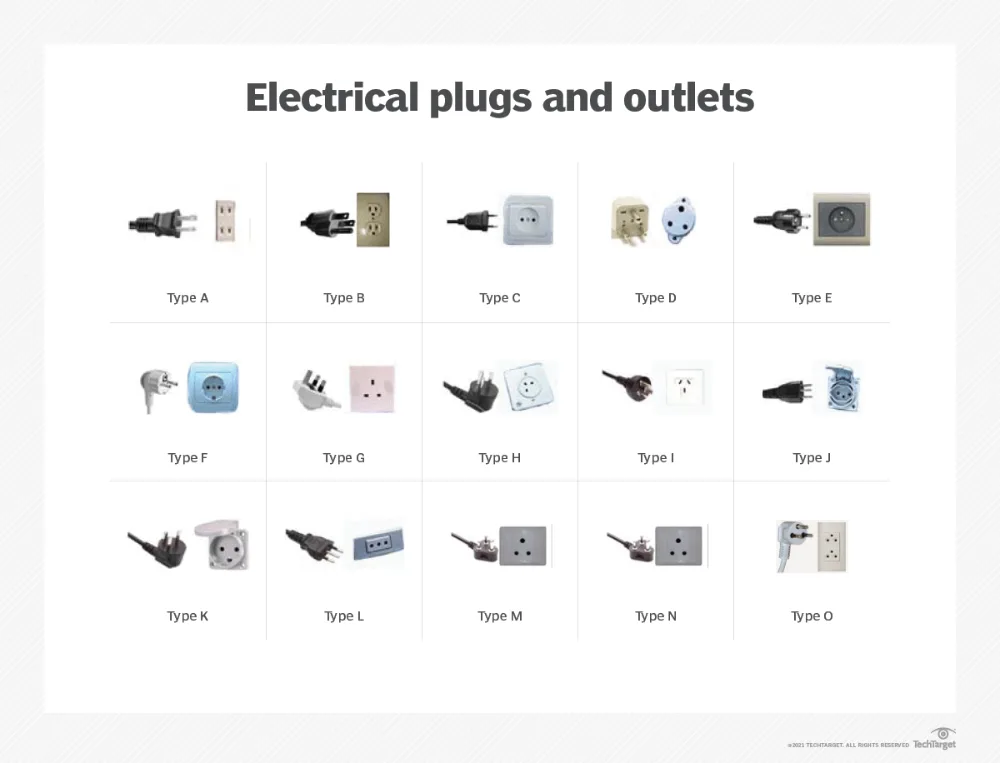
- Plug types: around 15 types, labelled A to O, are in use worldwide.
The same model needs a different element, power rating and plug for each market, so confirm the specification before ordering a water heater.
4.4. Safety Features
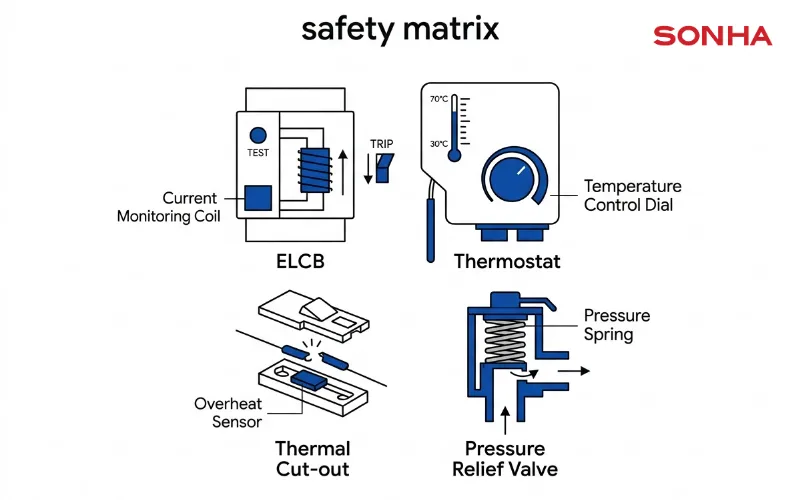
Water and electricity sit side by side in a bathroom, so check for these protections:
- ELCB: cuts the power instantly when it detects current leakage.
- Water-resistant casing: an IPX4 rating protects internal parts in a humid bathroom.
- Thermostat and thermal cut-out: stop heating at the set temperature and prevent overheating and scalding.
- Pressure relief valve: releases excess pressure from the tank.
- Flame-retardant materials: reduce fire risk in the casing and wiring.
4.5. Certifications and Compliance
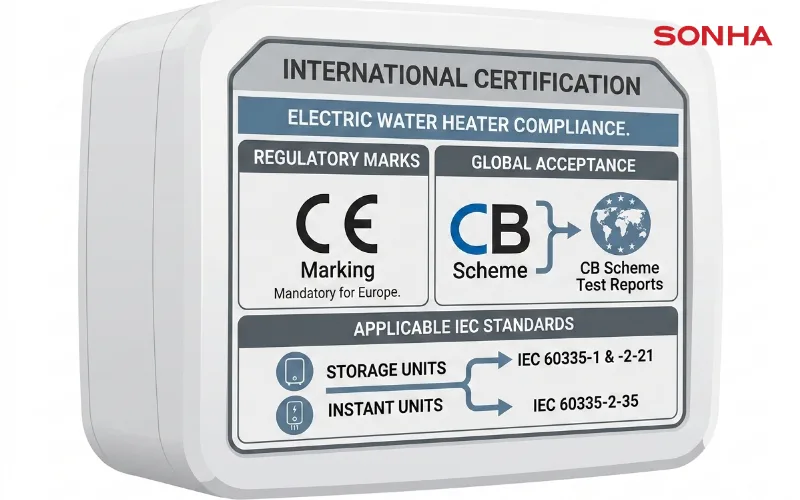
- Storage water heaters: IEC 60335-1 with IEC 60335-2-21 (2022 edition).
- Instant water heaters: IEC 60335-2-35.
- Heat pump water heaters: IEC 60335-2-40, which covers sanitary hot water heat pumps.
- CB Scheme: test reports accepted by participating countries as a basis for national certification.
- CE marking: required for Europe and often requested by buyers elsewhere.
Some markets add national marks, so ask each supplier for certificate scans showing model numbers and the issuing body of the electric water heater.
4.6. Build Quality and Manufacturer Reliability
Check what is inside the casing and who stands behind it:
- Inner tank: enamel-coated steel resists corrosion.
- Anode rod: a magnesium rod corrodes in place of the tank and should be checked regularly.
- Insulation: high-density PU foam cuts heat loss.
- Serviceability: a removable element makes maintenance easier.
- Supplier: when comparing water heater manufacturers, choose an electric water heater manufacturer with verifiable certificates, documented QC, openness to factory audits, clear OEM design ownership and reliable spare parts.
4.7. Energy Efficiency
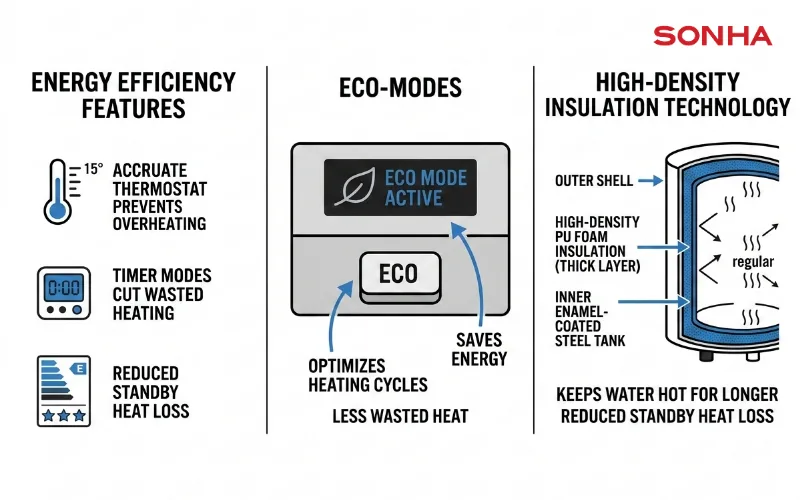
- Thicker insulation reduces standby heat loss.
- An accurate thermostat avoids overheating.
- Timer or eco modes cut wasted heating.
- Heat pump models are two to three times as efficient as conventional electric resistance heaters.
Check whether your market requires an energy label or a minimum efficiency level.
4.8. Installation Space and Total Cost of Ownership
Below are the key factors regarding installation space and the total cost of ownership to keep in mind when selecting a water heater.
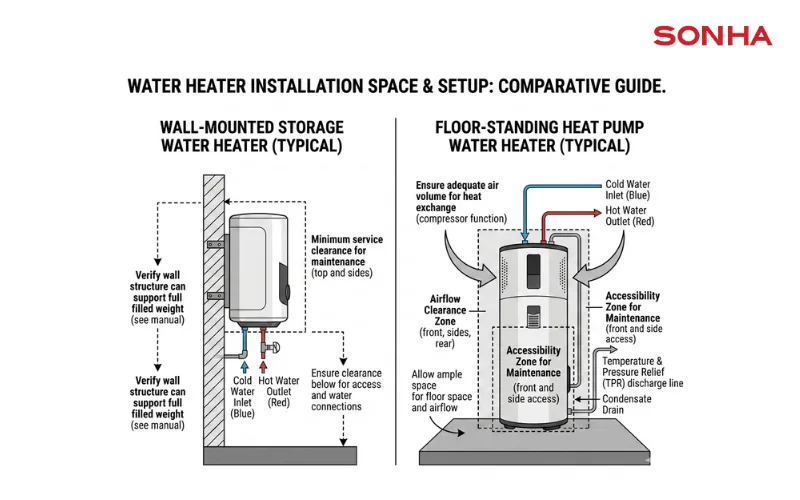
- Space: wall-mounted tanks for bathrooms, compact instant units for tight spaces, floor space and airflow for heat pumps.
- Total cost of ownership: purchase price, installation, electricity over the product’s life and maintenance.
- Landed cost for importers: add sea freight and import duties; a slightly higher factory price can still win if duties or freight are lower.
5. How to Use and Maintain a Water Heater Safely
Safe use comes down to three habits: professional installation, sensible daily use and regular maintenance. Distributors can share these points with end users to cut breakdowns and warranty claims.
5.1. Safe Installation
- Have a qualified electrician or plumber install the unit, following the manufacturer’s manual and local codes.
- Connect the heater to an earthed circuit with its own correctly rated breaker or ELCB.
- Fit the pressure relief valve in the right direction and keep its discharge line clear.
- Mount storage tanks on a wall that can carry the full weight of the tank when filled.
- Fill the tank completely with water before switching on the power, so the element never heats dry.
- Place heat pump units where there is enough air volume and the room stays within the manufacturer’s temperature range.
5.2. Everyday Use Tips
- Set the thermostat to around 49°C (120°F) to balance energy use and scald risk.
- Press the ELCB test button regularly to confirm the leakage protection still trips.
- Switch the heater off before long trips to save energy.
- If you notice tingling, sparks or leaks, cut the power and call a technician. Do not open or repair the unit yourself.
5.3. Periodic Maintenance
A storage water heater needs regular sediment flushing, anode rod inspection and a check of the temperature and pressure relief (TPR) valve, plus a professional inspection once a year. On older units, a TPR valve test can cause a leak, so follow the manual or leave it to a technician.
| Task | How often | Why it matters |
|---|---|---|
| Flush sediment from the tank | Regularly; more often with hard water | Sediment reduces efficiency and can clog water lines |
| Check the anode rod | Regularly, during each flush | Catches heavy corrosion before the tank rusts |
| Replace the anode rod | Under ½ inch (13 mm) thick or coated with calcium | Protects the inner tank from rust |
| Check the TPR valve | As the manual allows; yearly professional inspection | Confirms the safety valve still opens |
| Clean the inlet filter or showerhead (instant models) | As the manual advises | Keeps flow and heating steady |
Hard water speeds up sediment buildup, so homes in hard-water areas need more frequent flushing.
6. SONHA Water Heater: A Trusted Water Heater Manufacturer and Exporter
SONHA Water Heater is a Vietnamese water heater manufacturer supplying storage, instant and heat pump models to importers, distributors and brand owners. Our electric water heater range is built for export, with configurations matched to each market.
6.1. Why Choose SONHA Water Heater?
Our story began in 1998, when SONHA Group started making stainless steel water tanks. We began manufacturing water heaters in 2016 under the SHI model, and today we operate as a dedicated water heater manufacturing company with:
- 10+ years of manufacturing experience: a mature production process for electric water heaters.
- 4,880 m² production area in Vietnam: an in-house water heater factory, not a trading intermediary.
- 5+ export markets across Asia, North America, Africa and Australia: SONHA Water Heater has exported 15L, 20L and 30L water heaters to Indonesia, Uruguay, Tanzania, Argentina and Australia, gaining experience with different voltages, plug types and market requirements.
- 1M+ units/sets of annual capacity: room for large orders and steady delivery schedules.
- International certifications (CB, CE and international standards): a strong starting point for product registration in your market.
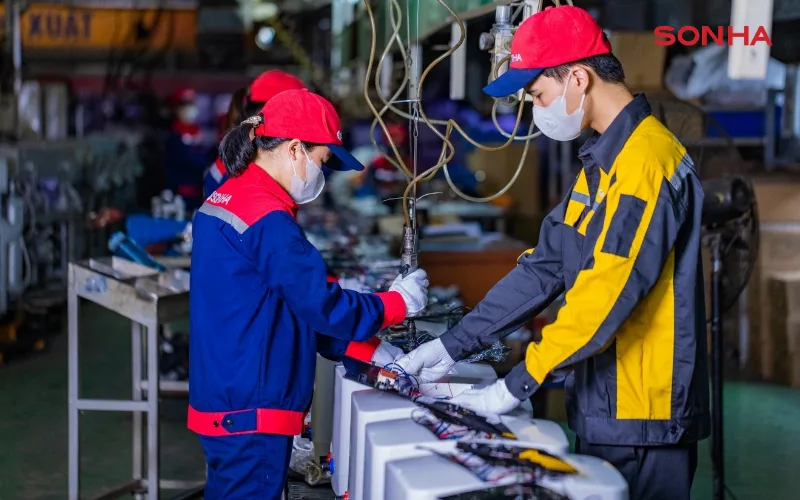
SONHA Water Heater build quality control into every stage of water heater manufacturing. Our OQC team at SONHA Water Heater carries out electrical safety testing and applies a “QC Pass” label before each unit is packed.
6.2. SONHA Water Heater Products and OEM/ODM Services
SONHA Water Heater’s product range covers the three main water heater types:
| Type | Capacity and power |
|---|---|
| Storage | 15–30 L; 1,500–2,500 W |
| Large-capacity storage | 50, 80, 100 L; 800–2,500 W; 220–230 V or 110–127 V |
| Instant | 4,500 W; 7.2 L/min |
| Heat pump | 200 – 270 L (all-in-one); 160 – 300 L (split system) |
For brand owners, SONHA electric water heater factory offers full OEM and ODM support, backed by more than five years of OEM experience:
- Consultation on target market and specifications
- OEM engineering and samples for approval
- Order confirmation
- Manufacturing
- Final inspection
- Global delivery and after-sales support
We also help design your packaging and labels. Our production lead time is typically 30–45 days for standard products and 45–60 days for OEM/ODM projects. Learn more about SONHA Water Heater’s OEM & ODM water heater manufacturing in Vietnam.
7. Frequently Asked Questions
7.1. Which is better: an instant, storage or heat pump water heater?
The right water heater depends on the home. An instant heater suits a small bathroom with one outlet in a warm climate. A storage heater suits families that need hot water at several outlets at once. A heat pump suits high-demand homes that want the lowest running cost and can accept a higher upfront price.
7.2. How long does an electric water heater last?
A tank water heater typically lasts about 8–12 years and can reach 15 years or longer with proper care and maintenance. Water quality, usage and anode rod condition strongly affect lifespan.
7.3. How often should a water heater be serviced?
Flush the tank about every six months, test the TPR valve once a year and check the anode rod regularly. Homes with hard water need more frequent flushing.
7.4. What certifications does an electric water heater need for export?
An electric storage water heater is usually assessed to IEC 60335-1 and IEC 60335-2-21, often proven through a CB Scheme test report and CE marking. Instantaneous models follow IEC 60335-2-35 instead. Many importing countries add their own national mark, so check the target market’s rules and ask the manufacturer for certificates that list the exact model numbers.
7.5. Does SONHA Water Heater offer OEM water heaters?
Yes. We provide OEM and ODM services, including packaging and label design. Our lead time is typically 30–45 days for standard products and 45–60 days for OEM/ODM projects.
The right choice among water heater manufacturers comes down to three things: a heater type that fits the climate and usage, a configuration that matches the target market’s voltage, plugs and certifications, and a factory that can prove its quality and support. At SONHA Water Heater, we combine all three for importers and distributors.
Explore SONHA Water Heater’s electric water heater range or contact our export team at:
- Email: export@sonha.com.vn
- WhatsApp: +84 983 604 297.